










For years, Indians have leaned instinctively towards paint. It’s what we grew up seeing on our walls and believed to be the most durable choice money could buy. But as wallpapers steadily make their way into modern Indian interiors, the real question is longer paint or wallpaper, but which truly offers best cost efficiency, durability, and long-term value.
Paint still wins for short-term flexibility and easy touch-ups, while wallpaper delivers stronger visual impact and better value over time when maintenance, durability, and aesthetics are considered together.
So, if you’re styling a modern home and wondering which option your investment should go with, this blog will help you break down both paint and wallpaper to help you decide what suits your space and lifestyle the best.
Wallpaper vs Paint: A Quick Overview

Before we dive into the nitty-gritty of costs, installation, longevity, and so on, let us first get the basics right by understanding what paint and wallpaper is:
1. Paint
- Conventional choice for decades as it is a smooth and reliable option.
- You can play with multiple colour palette options depending on your interiors and preferences.
- Lasts up to 5 and more years, surviving wear and other drawbacks on the wall.
2. Wallpaper
- Pre-designed wallcoverings that contain textures, patterns, or murals.
- Comes in rolls and has to be activated through paste or self-adhesive backing.
- Endures 10 years of wear and tear.
Style & Aesthetic Impact
When you’re upgrading the walls of your home, the first thing that comes to mind is whether the option you choose, paint or wallpaper, is making a visual impact or not. Depending on what type of visual statement you want to achieve, here are the style and aesthetic impact of paint and wallpaper:
1. Paint
- There are infinite colour mixes, ideal for spaces where light affects the visual impact.
- You can choose to go with subtle and light colours for an airy ambience or dark and moody for an ambient atmosphere.
- Textured paints that mimic subtle grain are suitable for those who want a tactile appeal on their walls.
- Can also be used to create visual illusions such as lighter shades make small rooms feel open while darker shades add intimacy to expansive rooms.
2. Wallpaper
- Wallpaper instantly provides ready-to-go designs, transforming walls within seconds.
- Wallpapers offer a plethora of designs, 3D effects, and faux textures that give a dramatic effect.
- It outperforms paint in pattern scale, delivering the ‘wow’ factor intended.
- Gloss, matte, textured wallpaper finishes all provide the visual and tactile sophistication to the walls.
Initial Cost Breakdown: Material + Labour

Let’s compare the initial cost breakdown of paint vs wallpaper through the tabular format below:
| Aspect | Paint | Wallpaper |
| Materials | ₹8 per sq. ft. for distemper paint to ₹80 per sq. ft. for premium or textured paint. | ₹30 per sq. ft. for basic vinyl or paper-based options; ₹500 per sq. ft. for premium non-woven and fabric options. |
| Labour | ₹10-₹50 per sq. ft. depending on the city, paint type, and complexity. | Installation costs start from ₹10 per sq. ft., depending on the city. |
| Total | ₹18- ₹130 per sq. ft. | ₹40-₹510 per sq. ft. |
Installation Time, Mess & Downtime
Don’t you want to know which among the two options makes a greater mess, has a long installation period, and downtime? Let’s find out below:
1. Paint
- Preparing the wall– taping, patching, priming– takes up 2-4 hours, sometimes a day or two depending on the area or rooms you’re planning to paint.
- Takes 2-4 days per room, accounting for 2-3 coat applications and drying time between these coasts.
- Creates a bit of mess such as paint splashes, strong odour, covered furniture and floor and taped edges.
- Rooms often become unusable during painting.
- Required post-painting cleanup once the paint is dried and set.
2. Wallpaper
- Installation is usually completed within a few hours to one day, depending on the room.
- Minimal mess creates as wallpapers do not emit odour, avoids mess, and require no floor and protection.
- Rooms can often be used the same day after installation.
- Furniture needs to be moved temporarily but can be placed back immediately.
- Little drying time is required for the adhesive to firmly stick to the wall and wallpaper.
Durability & Lifespan Comparison
Which option, paint or wallpaper, performs better over time? Let’s find out below:
| Aspect | Paint | Wallpaper |
| Average lifespan | 5-7 years in typical Indian conditions with occasional touchups | 8-12 years with good quality and installation |
| Performance over time | Gradual fading, stains, chipping, and scuff marks | Retains colour and texture longer |
| Impact of Humidity | Moisture-resistant paints perform well over time | Can peel or bubble in high humidity and poor ventilated areas |
| Sunlight Exposure | May fade on sun-facing walls | More colour-stable indoors |
| Wear and tear | Scratches, stains, and marks are visible over time | More resistant to everyday scuffs and scratches |
| Maintenance | Easy touch-ups, repainting required | Minimal maintenance, easy to clean |
| Wall Prep Dependency | Moderate | High, as surface must be smooth and dry for better adhesion |
Maintenance, Cleaning & Repaint Cycles
The process does not end at installation only, maintenance and cleaning follow suit. Let’s look at how both wallpaper and paint should be maintained and cleaned:
1. Paint
- Required periodic repainting every 3-5 years to maintain the fresh look.
- Prone to stains, scuffs, and fading, especially in high-traffic areas.
- Can be wiped by a damp cloth but excessive cleaning may remove paint.
2. Wallpaper
- Low-maintenance once installed, with no frequent replacement.
- Easy to clean using a soft microfibre or mild cleaning solutions.
- Retains colour and finishes longer without dulling.
Repairability: Fixing Damage Without Full Replacement
Which amongst the two, wallpaper or paint, has better repairability without the need of entire replacement? Let’s find out below:
1. Paint
- Minor scuffs, stains, and scratches can be spot-painted easily.
- Small cracks or chips on the edges are repairable with touch-up paint.
- Colour matching can be slightly tricky over time due to fading.
- More forgiving for renter homes and frequent wear and tear.
2. Wallpaper
- Small tears, bubbles, or peeling edges are harder to fix invisibly.
- Patch repairs often remain noticeable due to pattern and colour mismatch.
- The wallpaper can be replaced with a peel-and-stick option.
- Peeling edges can be glued again with a strong adhesive.
Long-Term Cost Comparison Over 8–10 Years
Let’s look at the long-term cost comparison on paint vs wallpaper in India over an 8-12 year period:
1. Upfront Cost and Lifespan of Paint
- Initial Cost: Around ₹12- ₹35 per sq. ft. for standard interior paint, including material and labour.
- Lifespan Before Painting: Typically 5-7 years for good quality emulsion.
- Repainting Cycle: Depending on the climate and environment, every 3-5years.
2. Upfront Cost and Lifespan of Wallpaper
- Initial Cost: More expensive initially often starting from ₹50-₹150 (or more) per sq. ft. , excluding installation charges.
- Lifespan: High-quality wallpapers can last 8-10 years or even 15 years with good care and maintenance.
- Replacement Cycle: Often no replacement needed within 8-12 years if wallpaper quality, installation, and wall health are solid.
3. Durability and Maintenance Cost of Paint in Indian Conditions
- In Indian weather, even good quality paint may require repainting around year 5-7 due to fading, water and algae stains, and wear.
- Repeated repainting adds to cost.
4. Durability and Maintenance Cost of Wallpaper in Indian Conditions
- If installed well and kept in mostly dry conditions, wallpaper can hold up without replacement for 8-12 years, minimising any expenses.
- However, in high-humidity areas like bathrooms or kitchens, edges can peel or bubble, requiring repair and replacement.
Paint vs Wallpaper in Indian Climate Conditions
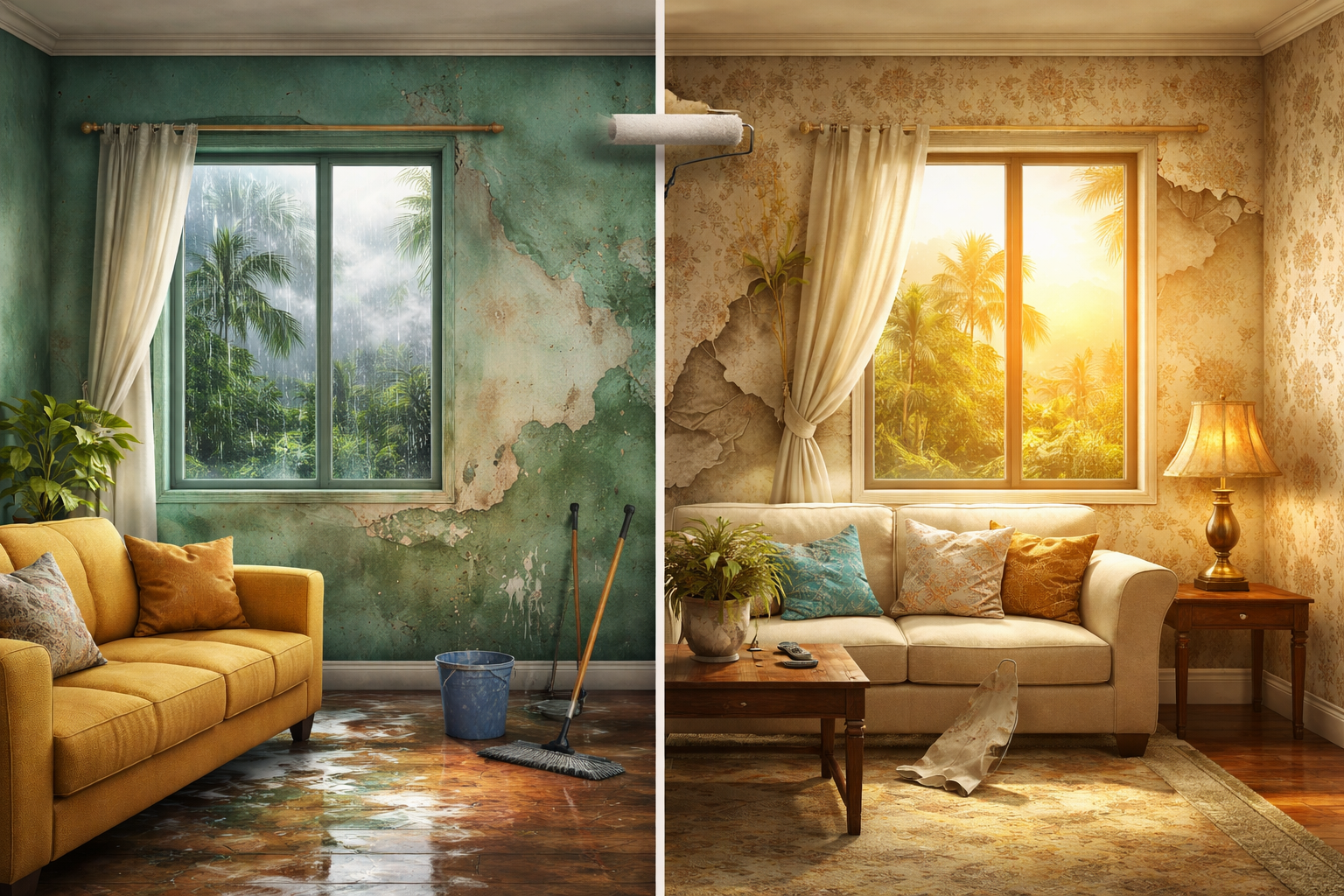
In Indian homes, our walls don’t just stand and look pretty, they deal with heat, humidity, dust, and long monsoons, which makes climate a surprisingly important factor when choosing between paint and wallpaper. Let us take a closer look whether paint or wallpaper is suitable for Indian climate conditions:
Paint in Indian Climate Conditions
- Handles humidity better when moisture-resistant or washable paints are used.
- Easier to maintain in hot and dusty regions where walls need dust cleaning.
- Less prone to peeling during monsoons, especially on exterior-facing walls.
- However, paint can fade faster in home with constant sun exposure and may show damp patches in poorly ventilated areas, requiring repainting.
Wallpaper in Indian Climate Conditions
- Works well in dry, air-conditioned interiors, especially living rooms and bedrooms.
- Monsoons can cause bubbling or edge peeling if walls aren’t perfectly adhered to the wallpaper with a strong glue.
- Vinyl wallpapers resist water and dust, making it easy to clean and maintain.
- Textured and vinyl wallpaper perform better outdoors but still need regular check-ins and maintenance.
Health, Safety & VOC Considerations
When it comes to walls, what goes into them matters just as much as how they look. Trusted brands like Magicdecor prioritise family health, the environment, and indoor air quality, ensuring wallpapers are as safe as they are stylish.
- Choose wallpapers that are printed using water-based and VOC-free inks that do not release harmful toxins into the air.
- Opt for wallpapers that are suitable for homes with children, pets, and sensitive individuals due to low chemical emissions.
- Paper and materials should be sourced from FSC-certified forests, ensuring responsible and sustainable practices.
Suitability for Rented Homes
No matter how temporary a rented house is, it still becomes home. And naturally, there’s always the urge to personalise it but it comes with its own set of boundaries– landlords, security deposits, and the constant fear of damage. So, based on rented-home realities, here’s how paint and wallpaper fare:
1. Paint
- Allows easy and inexpensive updates without the risk of permanent damage.
- Paint jobs are budget-friendly, especially if you’re staying temporarily somewhere.
- Painting can however be messy, time-consuming, and inconvenient in a rented space.
- Paint alone may feel too plain if you’re craving statement walls or texture.
2. Wallpaper
- Wallpapers add instant texture, patterns, and personality without structural changes.
- Peel and stick wallpapers are designed with renters in mind who need a quick, hassle-free decor solution.
- When removed correctly, they do not leave behind adhesive residue or damage the walls.
- Using low-quality or rushing the removal process can risk wall damage.
Paint vs Wallpaper: The Pros and Cons
Let’s look at the tabular differences between the pros and cons of paint vs wallpaper:
| Category | Paint Pros | Paint Cons | Wallpaper Pros | Wallpaper Cons |
| Cost | Low upfront costs | Frequent repaints so long-term expenses. | Lasts longer so no additional costs. | Higher upfront costs |
| Installation | Process takes up days | Multiple coats and drying time. | Instant application within a few hours. | Requires skilled professionals. |
| Maintenance | Simple touchups, washable sheens. | Regular recoats needed | Wipeable surface, minimal maintenance | Seams peel over time and turn yellowish. |
| Ease of Application | Moderate prep work and simple application. | Requires a smooth surface and prep. | Beginner-friendly with self-adhesive backing. | Requires a smooth and moisture-free surface. |
| Aesthetics | Infinite colours to choose from | Flat surface with minimal patterns | Multiple designs and patterns with luxury textures. | Overwhelms small spaces, especially of trends shift. |
Final Verdict: What Makes Sense for Modern Indian Homes
There isn’t a clear winner when it comes to paint vs wallpaper and that’s exactly the point. Paint continues to make sense for homeowners who value flexibility, easy repairs, especially in high-traffic areas of their house. At the same time, wallpaper proves its worth in homes where longevity, design consistency, and low replacement cycles are priorities.
Both these options come with their own costs, maintenance needs, and limitations, and neither is a one-size-fits-all solution. The smarter option for modern Indian homes would be to assess how each room is used, the level of wear it will see, and the kind of value you want your wall to deliver over time and then you will have an answer.
FAQs
- Is wallpaper more expensive than paint in the long run for Indian homes?
Wallpaper may have a higher upfront cost, but its longer lifespan and lower replacement frequency can make it cost-effective over 8-12 years compared to multiple repaint cycles.
- Which option works better for Indian climate conditions?
Paint handles moisture and heat better in poor ventilated areas, while high-quality wallpapers perform well in dry, less humid spaces when installed correctly.
- Can wallpaper be used in rented or temporary homes?
Absolutely, self-adhesive or peel and stick wallpapers are suitable for rentals where a temporary decor solution is crucial without the fear of damaging the walls.
- Should modern homes use only one option or a mix of both?
Many modern Indian homes combine both paint and wallpaper, where paint is used in high-traffic areas and wallpaper in living rooms or bedrooms as feature walls.










 Material Preview
 Digital Snapshot
 Design Selection
