








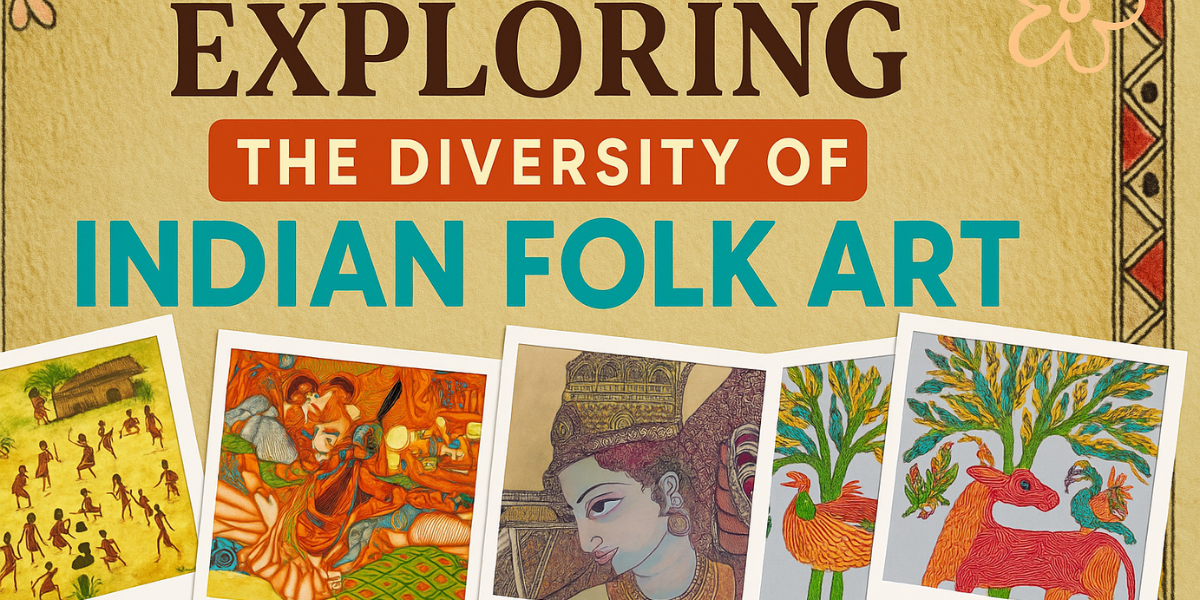
“If the world is a drawing then India is the land that adds colours to it. “
Anywhere you go in the country, you will find rich and diverse artistic traditions that are not just a delight to look at but speak of age-old traditions of devotion and storytelling.
Did You Know? India has over 50 folk art forms! One of the highest in the entire world.
Let us explore some of these ancient Indian folk art forms from all parts of India and look at their interesting origins and key characteristics.
1. Madhubani Art also known as Mithila Art (Bihar)
Madhubani art is one of the most popular art forms of India and is also known as Mithila art.
- This folk art originated in Bihar
- It is characterised by bright and solid colours without any gradients or shading.
- The colours used to create Madhubani art are obtained naturally. For instance, yellow is made out of turmeric and red from the juice of the kusum flower.
- A special kind of paintbrush made out of a bamboo stick covered with cotton cloth is used for painting.
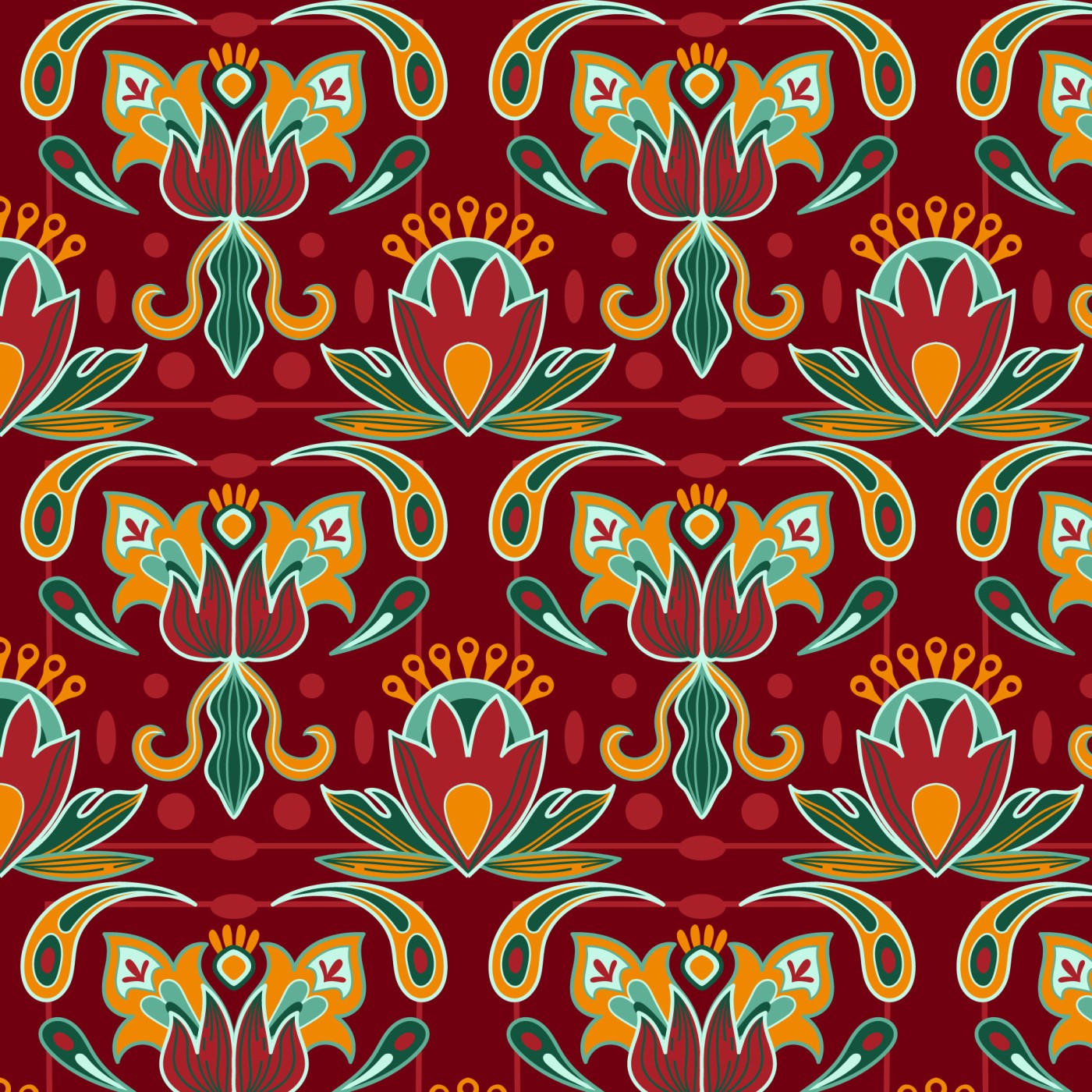
Check out this Madhubani style wallpaper Mural by Magicdecor
2. Miniature Paintings (Rajasthan)
Miniature paintings are one of the most celebrated art forms of Rajasthan with a rich historical background.
- Though small, the paintings have intricate details that require skilled and fine brushwork.
- Miniature paintings often depict scenes from courtly life, romantic tales, and narratives from Hindu mythology.
This Emotional Alchemy Miniature Painting Wallpaper Mural from Magicdecor is perfect for your living room!
3. Phad Paintings (Rajasthan)
Another art style that comes from Rajasthan is the Phad paintings.
- These paintings are made not on paper but on cloth.
- The name of this Indian folk art is derived from the scroll-like base which is called Phad.
- Religious scenes were painted upon these scrolls which were then used while singing and performing these tales.
- Naturally sourced pigments were mixed with water and gum to paint the fabric.
Looking for Ganesh Chaturthi home decor ideas? Welcome lord Ganesha to your home with our Lord Ganesha Phad Art Wallpaper.
4. Bhil Art (Rajasthan, Madhya Pradesh, Gujarat)
Practiced in various parts of Central India, Bhil art gets its name from the Bhil tribe that invented this folk art.
- Motifs and designs of Bhil art are deeply connected with the community’s traditions, rituals, and spiritual beliefs.
- The Bhil community is largely an agricultural community. Therefore, nature-inspired designs are central to their art form.
- The most unique feature of Bhil art is their use of dots to create a textured appearance in the paintings.
- The famous Pithora paintings are a part of Bhil art and are used to worship the Bhil deity known as Pithora.
5. Saura Painting (Odisha)
Saura paintings from Odisha are a form of Indian wall art that gets its name from the Saura tribe.
- The members of the Saura tribe used to decorate the walls of their huts during celebrations and festivities.
- Commonly used motifs and icons such as the sun, the moon, and angular human figures, symbolised their daily lives, traditions, practices and culture.
6. Santhal Painting (West Bengal, Jharkhand, and Odisha)
Santhal paintings also originated around the same area as Saura paintings and are named after the Santhal tribe.
- Santhal paintings are made using primary colours – red, yellow, and blue.
- These paintings often depict everyday tribal life, mythological tales, and nature motifs.
Fun Fact! Rabindranath Tagore promoted Santhal Art in Shantiniketan.
7. Pattachitra Art (Odisha and West Bengal)
Odisha and West Bengal not just boast of different wall art styles but are also home to textile art forms such as the Pattachitra.
- Patta means cloth and chitra means art.
- Pattachitra is a form of scroll painting that originated for devotional and ritualistic purposes and showcased Hindu myths and legends.
- Deities like Lord Krishna and Jaganatha are often central figures of Pattachitra art.
- Delicate brush strokes are a key feature of Pattachitra paintings.
This Pattachitra painting wallpaper mural from Magicdecor is perfect for those who want to add a traditional touch to their modern homes.
8. Kalighat Painting (West Bengal)
Kalighat paintings are a specialized form of Patachitra art practiced in West Bengal.
- These paintings were first made by scroll painters known as the patuas who lived near the temple of goddess Kali in Kolkata.
- This is why the goddess is the central figure in most of the Kalighat paintings although some of them feature scenes from everyday life as well.
- The most distinguishing characteristic of this Indian artwork is the contrast between minimalist backgrounds and thick outlines filled in with vivid colours.
Did You Know?
Kalam Patua is a contemporary Kalighat painting artist who is credited with the revival of this art form. He introduced modern themes that offer social commentary on various issues and even adds autobiographical elements to his artwork.
Check out Magicdecor’s collection of Kalighat painting wallpapers to create statement walls that catch attention.
9. Mata Ni Pachedi (Gujarat)
Originating in Gujarat, Mata Ni Pachedi is one of the most unique folk arts of India.
- The Vagharis were a nomadic tribe living in Gujarat who faced marginalisation in the society. This meant they were often not allowed inside temples.
- The Vagharis started painting female deities surrounded by worshippers, animals and birds on textile which was then utilised as a background for shrines.
Mata Ni Pachedi translates to ‘behind the mother goddess.’
- Originally only 2 colours – red and black – were used to paint the fabric.
You can now bring Gujarat’s hidden art to your walls with our Mata Ni Pachedi wallpaper made of premium materials.
10. Rogan Painting (Gujarat)
Rogan painting is a Gujarati art style that traces its roots to Persia from where it travelled to Kutch.
- The core material of Rogan paintings is castor oil that is boiled for days to create a thick paste which is then used as paint.
- It is a textile art. Skilled artisans paint mirror images with bright colours that pop against dark backgrounds.
11. Cheriyal Scroll Painting (Telangana)
Most forms of Indian paintings were not only used for decorative purposes but served as important tools of storytelling. One such folk art is the Cheriyal Scroll Painting from Telangana.
- Storytellers travelled from village to village, narrating tales from Indian mythology and used Cheriyal scroll paintings to aid them.
- These depictions were painted onto Khadi fabric.
- Cheriyal paintings always use red colour for the background while the designs are made using a variety of colours.
12. Nirmal Painting (Telangana)
Nirmal Paintings take their name from the town where they originated – Nirmal in Telangana.
- Their uniqueness lies in the base on which they are painted – teak wood.
- They are also distinguished by a special gold powder that is used to add gloss and shine to the artwork.
- Nirmal paintings feature no more than two figures painted with intricate details.
13. Kalamkari (Andhra Pradesh and Telangana)
Kalamkari is perhaps one of the most celebrated folk arts from India and was traditionally used to depict religious scenes within temples.
- It is a cloth-based art form. Intricate designs are painted onto fabric.
- The name is derived from the word Kalam, which means pen.
- Kalamkari art is practiced in 2 major styles – Srikalahasti (hand painting) and block printing.
Kalamkari art is no longer limited to textile. Adorn your living space with our collection of Kalamkari wallpapers.
14. Thangka Painting (Sikkim)
Sikkim also gave India a beautiful textile art form called Thangka that is made on a cotton or silk fabric.
- Thangka paintings feature Buddhist scenes and mandala designs.
- These are usually created for the purpose of meditation or to enlighten students in monasteries about the life and teachings of Buddha.
15. Chittara Art (Karnataka)
The Deevaru community of Karnataka gave the country a uniquely beautiful wall art known as Chittara art.
- Adorning their walls and floors, the paintings were traditionally made by the women of the community.
- Designs of Chittara art are also used in Rangolis.
16. Tanjore Painting (Tamil Nadu)
Tanjore is the anglicized name of Thanjavur paintings that have their origins in the Thanjore town of Tamil Nadu.
- Tanjore paintings are loved because of their simplicity in composition and the use of vibrant colours that instantly catch the eye.
- Unlike other art forms, these paintings also use materials like gold foil, precious gems, and beads made out of glass.
- The religious depictions of Tanjore art are done not on paper or cloth but on wooden planks.
Let your walls express your devotion with this Shiv Parivar Colourful Tanjore Painting Wallpaper that is a complete masterpiece!
17. Gond Art (Madhya Pradesh)
Gond art from Madhya Pradesh is more like a storytelling device.
- Folk tales and stories of the Gondi culture make up most of the themes and subjects of these paintings.
- The paintings are characterized by the use of dots and lines to create geometric patterns
- Gond art can be found on the walls of the houses.
Bring the vibrant colours and patterns of Gond art onto your walls to add a pop of colour with tradition. Our recommendation – Chitraganda’s Chirp Gond Art Wallpaper.
18. Warli Art (Maharashtra)
Maharashtra’s famous Warli art is named after the Warli tribe and can be recognised by the simple geometric patterns and angular figurines.
- Warli art is mostly seen on mud walls.
- Natural pigments are used to create the paint.
- Snippets from everyday life, nature motifs, and depictions of the tribe’s rituals are commonly seen in these paintings.
Let tribal art travel from mud walls of huts to your house. Add a rustic touch to your living room with this traditional warli art wallpaper from Magicdecor.
19. Mural Paintings (Kerala)
The south Indian state of Kerala is home to magnificent mural paintings that adorn its temples.
- These temple murals are painted with naturally obtained pigments.
- Beautiful depictions of Hindu deities are a characteristic feature of these murals.
Browse through Magicdecor’s wide variety of Kerela mural wallpapers and let your rooms be transformed into works of art.
20. Manjusha Art (Assam)
Manjusha is an art form that is popular in Assam but also practiced in some parts of Bihar.
- This folk art is also known as snake painting because depictions of serpents abound in its paintings.
- What sets this art form apart is the use of narrative boxes that, when arranged sequentially, tell epic tales.
21. Bamboo & Cane Art (Assam, Nagaland, Mizoram)
India is not only rich in its art forms but also in terms of craft and bamboo and cane art from the northeast is testimony to that.
- A variety of decorative items are created out of bamboo and cane that are produced in large quantities in the region.
- Skilled practitioners also create furniture out of these materials.
22. Kangra Paintings (Himachal Pradesh)
Part of the Pahari Miniature School, Kangra paintings of Himachal Pradesh enjoy immense popularity because of their delicate depictions of themes inspired by the Sringar Rasa.
- Deities like Lord Krishna and Radha Rani are common subjects of these paintings.
- The paintings are also known for the greenery that is always a part of the background.
23. Phulkari (Punjab)
Have you ever seen Punjabi women draped in dupattas with beautiful embroidery? That is known as Phulkari.
- This is a type of folk embroidery that is often vibrant and colourful.
- Floral designs are the most popular but geometric patterns can also be seen on textiles with phulkari embroidery.
24. Basohli Paintings (Jammu and Kashmir)
Basohli paintings of Jammu and Kashmir are another folk art style that belong to the Pahari miniature school.
- Despite being small, these paintings are characterised by bold and vibrant hues.
- The themes blend together mythology with traditional folk art and Lord Krishna is often seen as the central figure.
25. Tribal Motif Paintings and Scrolls (Manipur)
The North-eastern state of Manipur brings its uniquely local take on epic like the Ramayana through its scroll paintings.
- Though lesser-known, these paintings depicting nature-inspired motifs are beautiful.
- Tribal motifs are also popularly used to decorate walls.
26. Tribal wall motifs & wood carving (Nagaland)
Wall painting is also a part of Nagaland’s culture but it is distinctly unique in its choice of themes.
- Apart from painting elements of nature, tribal motifs in Nagaland showcase the bravery of the warriors and the story of their ancestors.
- This folk art is also differentiated from the others because it is often carved in wood instead of being painted onto paper or textile.
Indian Folk Art: Colours and Patterns of History, Culture and Heritage
There is no other country as rich as India when it comes to folk art forms. Therefore, it is important that we take pride in our rich artistic heritage and culture and make efforts to maintain those artwork forms.
Here is how you can contribute towards the preservation and promotion of Indian folk art:
Choose wallpapers that depict Indian folk art;We recommend these wallpaper designs from Magicdecor to adorn your walls with traditional Indian folk art styles.
- Indian folk art inspired wall hangings are another great Indian wall decor idea.
- Buy original folk art pieces to support the indigenous communities that are keeping our rich artistic culture alive.
Dive into the world of vibrant Indian folk art with Magicdecor’s collection of premium quality wallpapers and murals!



 Material Preview
 Digital Snapshot
 Design Selection
