









“For a house to be successful, the objects in it must communicate with one another, respond and balance one another.”
Vastu is an ancient Indian science, laying down guidelines for architectural harmony and balance between you and the natural energies in your space. Over the years, countless beliefs have shaped people’s understanding of Vastu and its true essence is now clouded. Hence, Vastu Shastra myths are so common everywhere that people have started treating them as the ultimate truth.
Vastu in reality, offers numerous knowledge when applied correctly. Therefore, it is necessary to debunk its common myths so that you can stop relying on them.
Understanding Vastu Shastra and its Core Principles
Vastu Shastra is an ancient Indian science of design and spatial harmony that stresses the scientific alignment of living and working spaces according to natural forces. ‘Vastu’ means ‘house’ and ‘Shastra’ means ‘science’ and the entire purpose of Vastu Shastra is to attract positive cosmic forces that lead to a healthy, wealthy and prosperous lifestyle.
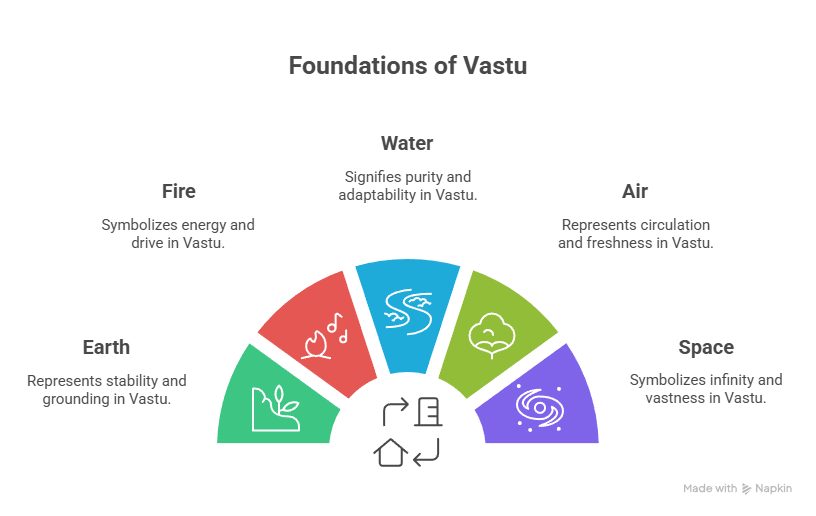
Vastu principles are based on five elements. They are:-
- Earth: For grounding and support
- Fire: Represents energy and drive
- Water: Stands for purity and adaptability
- Air: Symbolises circulation and freshness
- Space: Signifies Infinity and vastness
Did you know? Vastu is based on the rotation of the Earth on its axis and gravitational and magnetic forces created within it.
Truth Revealed: Common Vastu Myths You Should Stop Believing
Vastu is widespread and practiced by thousands of people and somewhere along the way, some concepts are riddled with misconceptions. Here’s some Vastu Shastra myths you should stop believing:-
1. By Not Implementing Vastu You Bring in Bad Luck
Fact: Vastu is not a superstition based on luck but rather intentional balance and harmony.
Many people worry that ignoring Vastu will invite misfortune and other bad luck which couldn’t be further from the truth. While, Vastu Shastra enhances the flow of energies within a space, it does not guarantee failure or success.
2. Vastu Delivers Instant Results
Fact: Vastu takes a long time to manifest and is not a quick fix.
Another one of the common Vastu Shastra myths is believing Vastu will provide immediate results. But on the contrary, it is a long process which depends on several environmental factors as well as incorporating positive habits.
3. Vastu is All About Directions Only
Fact: While directions play a role in Vastu, it is however, only one piece of the puzzle.
Many people believe that playing your bed in the southwest direction or south facing homes are unlucky. Instead of obsessing over the compass of the directions in every room, you should focus on well-ventilated rooms for easy energy flow.
4. Vastu is A Religious Practice
Fact: Vastu is not tied to faith but rather built on scientific principles.
Although Vastu has its roots in Hinduism, it is not a religious practice that is practiced by one belief. People from any belief can follow its principles to bring about optimistic energy flow in their living or working space.
5. Vastu Requires Major Renovations & Demolitions
Fact: Compiling to Vastu principles should not mean demolishing walls and spending a fortune.
Many people religiously adhere to the misconception that correcting Vastu means taking drastic measures like breaking down parts of the house that cost a lot. One one hand, some of these changes are required such as moving furniture around or adjusting colours. They can be practical and minimal and not large-scale.
Did you know? Vastu and astrology are interlinked and dependent on each. Your horoscope reveals your home and your home reflects your horoscope.
Key Elements of Vastu-Compliant House Design
These elements will guide you to make informed decisions when designing a Vastu-compliant home design.
1. Levelling All the Five Elements
As mentioned earlier, Vastu is governed by five elements of nature–fire, water, air, space, and earth which has to be balanced and represented individually in every vaastu compliant house plan.
2. Obeying Directions
North, South, East, and West might just be directions on the compass but they are significant in Vastu. Each of these along with the intermediate directions bring balance. When you are laying out your rooms, windows or doors, do it with respect to these directions and watch your home be grounded.
3. Well-Balanced Design Features
Colours and symbols also play a significant role in Vastu-compliant house plans where they bring out their own energies. Warm shades radiate passion and vibrancy while light tones bring about a sense of calm. By adding symbols of Om or a Lotus, you bring the positive flow of energy.
4. Incorporating Sacred Geometry
Shapes, especially sacred shapes like triangle, circle, rectangle and square, are an inherent part of Vastu-compliant home design. Placing Mandalas or Yantras around your space amplifies energy.
5. Spatial Planning
Each room in a Vastu-compliant house design has a purpose and carries on the activities in it. For instance, the living room is the central room where social interaction and entertainment takes place. On the account of this, it should have clear air pathways, proper arrangement of the furniture and minimal clutter.
Note: It is advised to consult the guidance of an expert on how to enhance your home using Vastu principles.
Start A Peaceful, Balanced Life With the Right Vastu Shastra
Vastu offers incomprehensible guidance on alignment, layout and balance in our space. But Vastu Shastra is misguided due to myths. Which is why the majority of the masses follow false theories and yield zero results.
By letting go of these common Vastu Shastra myths, you open your home and mind to its true possibilities. Whether you are opening a new office or building a new home, it is best to approach Vastu Shastra with the right perspective.









 Material Preview
 Digital Snapshot
 Design Selection
