








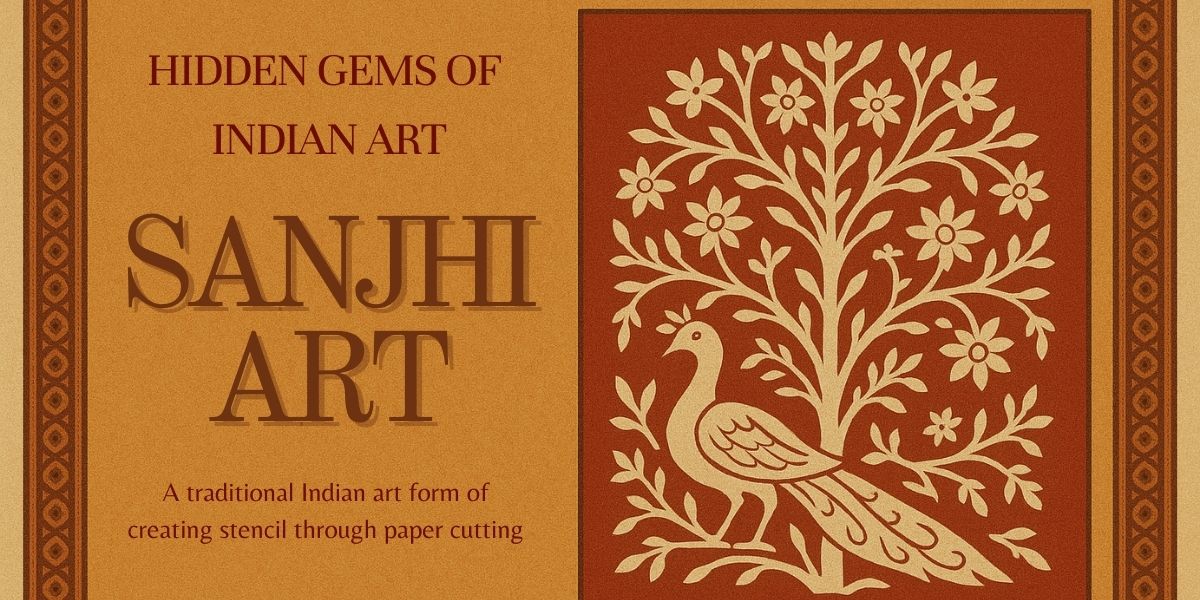
Have you ever cut out a simple stencil only to find that one wrong cut could ruin the entire design? Now imagine creating patterns to tell stories of gods using this fragile medium? Sounds like a challenge right? This same challenging art is in fact India’s hidden gem: the Sanjhi art.
What began as a sacred devotion to Lord Krishna has now become a rare, hidden art form. Continue reading to learn more about this endangered art, right from its origin to its practices.
Motifs And Mythology
Sanjhi is a historical and mythical art form of creating stencil through paper cutting. The term ‘Sanjh’ which is derived from the word ‘sajja’, translates to ‘dusk’, depicting the time of the day during which Sanjhi art was practiced.
This art form originated in the 16th century in Mathura and Vrindanvan, somewhere in Uttar Pradesh, whose origin is firmly ingrained in the Hindu mythology. As per tales, Radha started this concept. She would plaster coloured stones or flowers onto fresh cow dung to gain the attention of Lord Krishna. Seeing Radha do this, other gopis (milkmaids) followed suit.
What started as a love tale between Radha and Krishna, now takes forms into various different motifs. Particularly trees, cows, peacocks, bullock carts and other representations of the region.
Historical Roots And Revival: How This Art Survived Centuries
Originating from Mathura, the homeland of Lord Krishna, Sanjhi art gained its popularity among the temples of Krishna. Inspired by Radha, Kishna’s Sanjhi art grew popular on every wall in temples, depicting various mythological stories. But sadly, this art became rare.
Fortunately, Sanjhi art was revitalised by the Pancholi family living in Udaipur. The forefather, M. Madhav Pancholi introduced Sanjhi art in the Radha Wallabh Ji temple with his stencils. Today, his sons and grandsons continue to keep this art running through generations.
Unique Forms of Sanjhi Art Through the Ages
You will be surprised to know that Sanjhi art doesn’t just stop at paper stencils. It has many more varieties that developed over time due to creativity and modernity. Here are some impressive Sanjhi art forms:-
1. Paper-cut Sanjhi Art
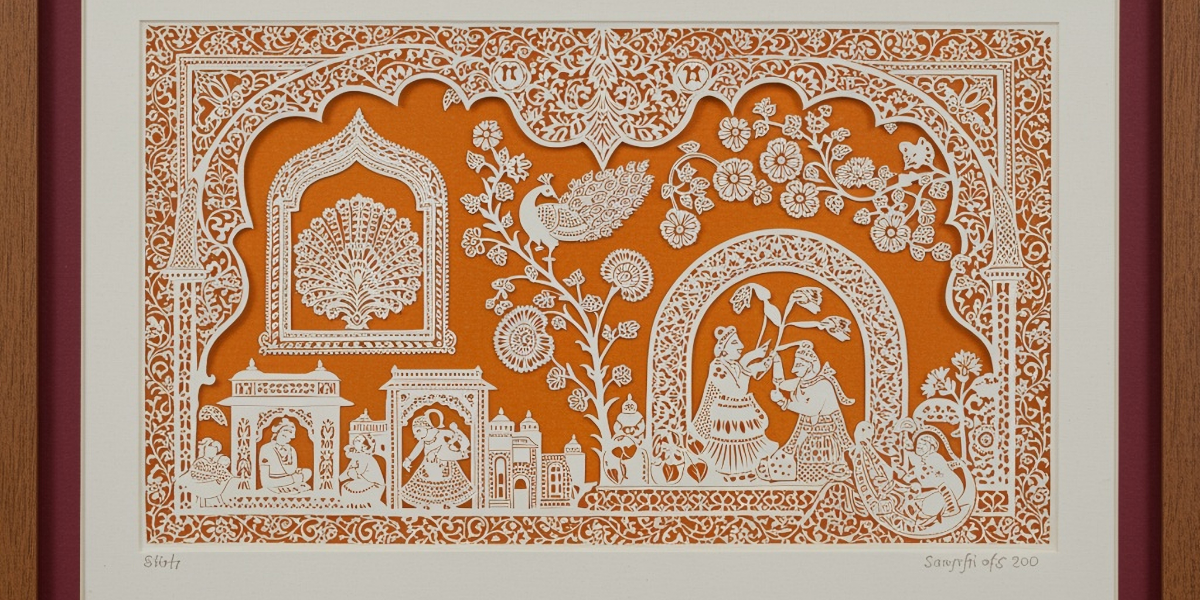
Paper-cut or stencil is a century old traditional Sanjhi art form that uses specialised scissors to create elaborate motifs. It requires utmost precision and stability to create the most mesmerising patterns.
2. Rangoli Sanjhi Art
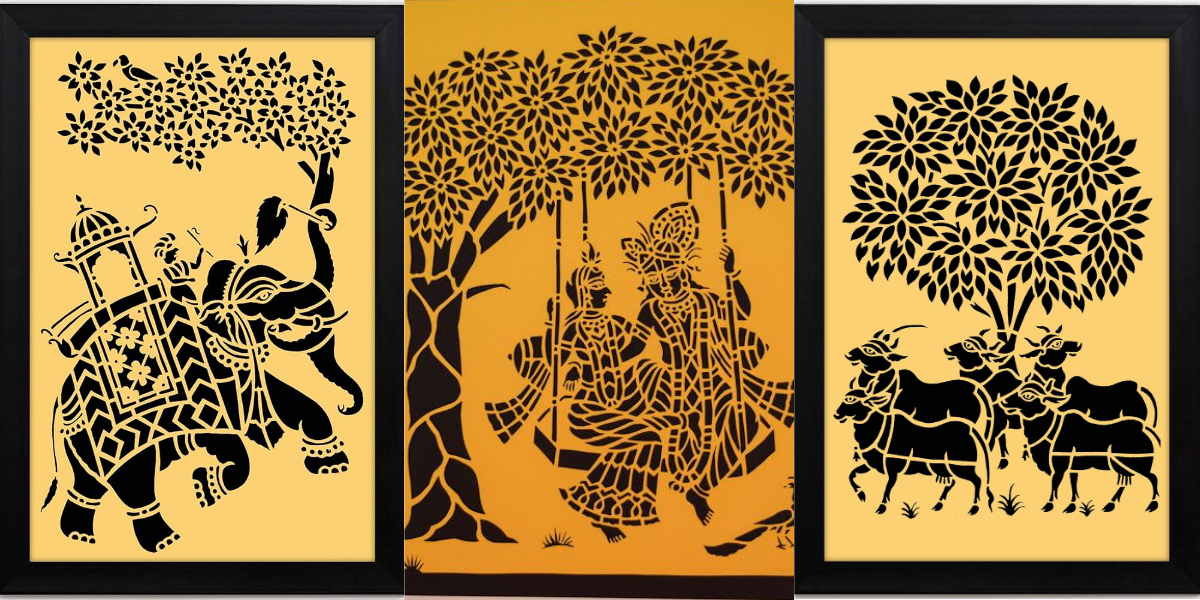
Rangoli Sanjhi art is created out of a paper stencil onto the ground or a tray with colourful powders. An intricate stencil is placed on a surface and powder is thrown onto it to create a coloured pattern.
3. Clay Sanjhi Art
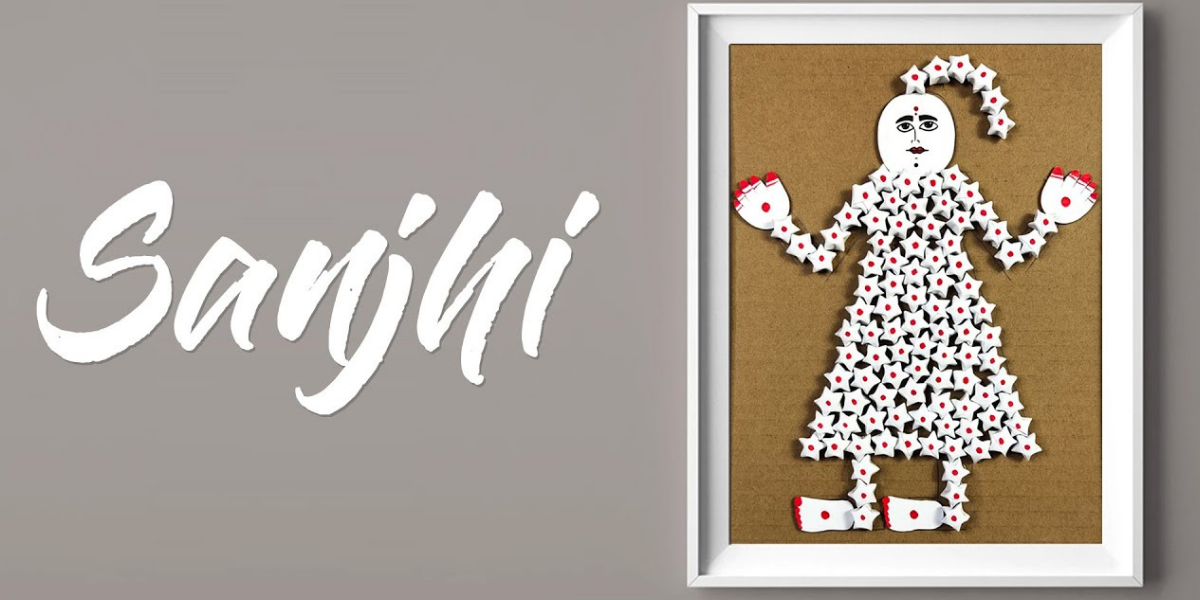
Gradually, Sanjhi art designs took form from paper to clay, where instead of the paper, the artisan used clay to build the motifs. These are hand-molded and sculpted onto walls and floors with bright colours.
4. Leaf Sanjhi Art
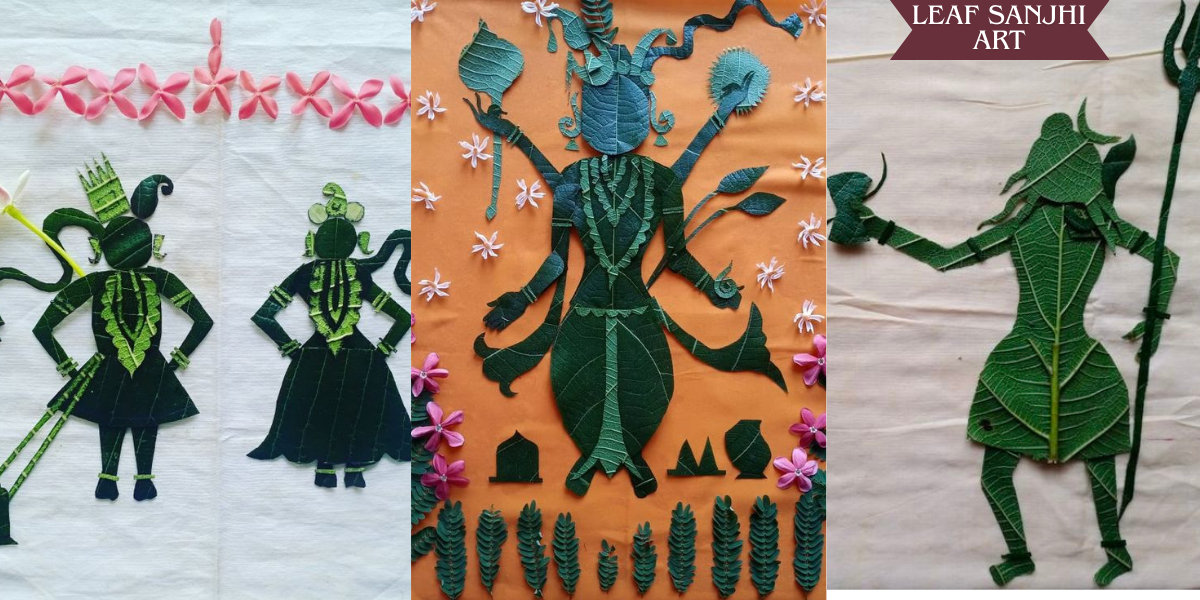
Following the footsteps of the ancient Sanjhi art first followed by Radha, leaf Sanjhi art is designed out of meticulously cutting leaves and arranging them to create a picture.
5. Jal Sanjhi Art
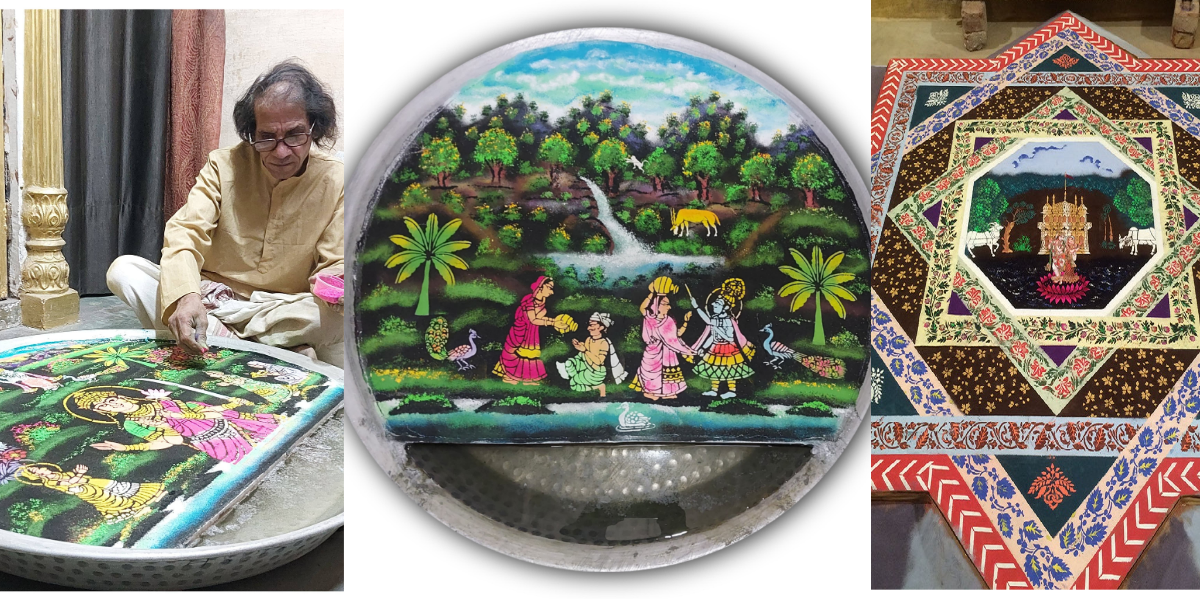
Jal Sanjhi art is a unique and immersive form of painting that uses water as a medium and colours that float. What makes this Sanjhi art more special is its fleeting beauty, dissolving as time passes.
The Process Behind the Art of Papers & Scissors
The craftsmanship behind Sanjhi art cannot be overstated- its intricate, delicate and calls for a great level of precision. Interestingly, almost all skilled artisans do not use an outline but rather freestyle. Here is their process of Sanjhi art paper cutting:-
1. Placing the Base
In ancient times, the base for Sanjhi art designs would primarily be of natural products such as cow dung or banana leaves. With time, this base evolved into a paper stencil which became the foundation of this artwork.
3. Outlining the Image
The artist will then outline the image onto the paper so that the design takes form. As mentioned earlier, some artisans cut papers without an outline, which must have taken years of practice to do so.
4. Using Specialised Scissors
This is the most important and delicate step involving cutting the motifs with extremely thin and long scissors. These scissors allow Sanjhi artists to cut delicate patterns with a steady hand.
5. Passing on the Design
Lastly, once the stencil is complete, it is then carefully placed on the ground, water or cloth and spread with coloured powders to reveal the full imagery. In some cases, artists may use a contrasting colour as the background for the stencil.
Let’s Carry Forward the Art Stencil of India!
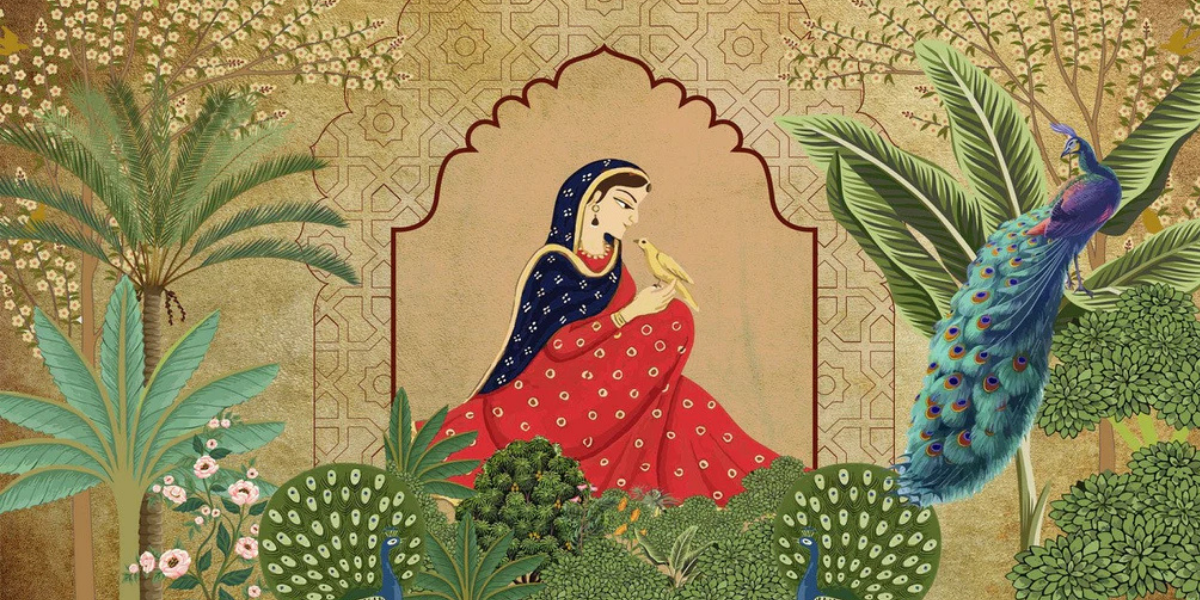
With time, this beautiful art is hardly known for its original self due to the decline in Sanjhi artists and interest in mainstream artwork. However, it’s too culturally significant to be lost forever.
Sanjhi art is a measure of love and devotion to Lord Krishna and is to be treated with great reverence. Therefore, we urge you to retain this hidden art form through any way possible:-
- Be it through the occasion of Janmashtami by buying Sanjhi decoration or crafts.
- Buying the works of Sanjhi artists like Ram Soni.
- Bringing Sanjhi inspired works to your spaces through Magicdecor’s wallpapers or murals.
In doing so, you are not only celebrating this hidden Indian art but also preserving it for coming generations. Afterall, who are we without our history and culture?
Art Should Be Known Not Hidden
India is home to a myriad of art forms all hailing from various states and regions, some centuries old while some new. It’s an inseparable part of our culture we cannot afford losing. Sanjhi art, too, has stood the test of time and must continue to withstand for many more years to come.








 Material Preview
 Digital Snapshot
 Design Selection
